
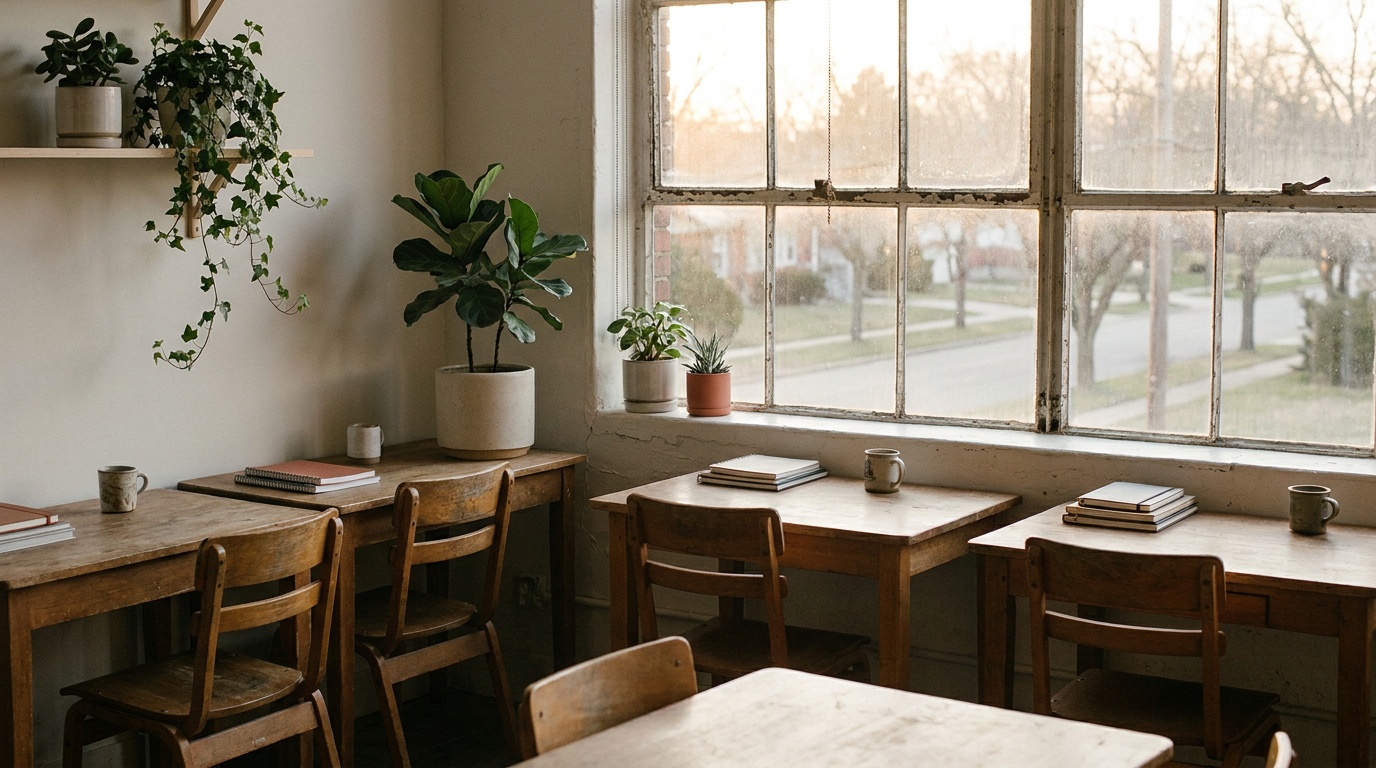

The studio is forty-one square meters on the second floor of a building that used to house a small offset printing shop. You can still see the bolt holes in the concrete where the presses were anchored. We moved in during the autumn of 2022, signed a six-month lease out of caution, and have renewed it four times since. Nobody has proposed moving anywhere else.
The room itself
Five desks line the two long walls, facing out rather than facing each other, which took some getting used to. Yuliia pushed for that layout after a previous office where everyone sat in a square and spent half the day making eye contact over monitors. Facing the wall sounds isolating until you realize it just means you talk when you mean to talk, not by accident.
What’s on the walls
One wall is cork board, floor to desk height, covered in printouts: screenshots pinned mid-review with red pen marks, a grid of type specimens from the Kovalenko Studio rebrand, a sheet of hex codes someone taped up in March and nobody has taken down. It is not curated. It is just where things go when they are being argued about.
Power, or the lack of it
Since the start of the blackout schedules, the studio runs on a 3.5 kilowatt generator kept on the landing outside, fed through a window gap sealed with foam board. It is loud enough that calls get rescheduled around it, and we’ve learned to time client calls for the two-hour windows when the grid is up. Marta keeps a spreadsheet of the rolling schedule updated from the regional utility’s channel, which has become, unofficially, the studio’s most consulted document.
We used to joke that the generator was the sixth member of the team. Then it needed an oil change and we realized we meant it.
What we don’t compromise on
Internet is the one thing we overpay for. Two separate providers, one fiber and one 4G router as backup, because losing a deploy window over connectivity is a kind of failure that’s entirely preventable and therefore unforgivable. Everything else, the furniture, the chairs, the secondhand monitors, we bought used or inherited from studios that closed.
The morning routine
Nobody sets an alarm for a shared start time. People arrive between 9 and 11, depending on the trains, the power schedule, or whether they worked late finishing a client revision. What’s fixed is the 11:30 stand-up, fifteen minutes, no slides, just each person saying what they’re stuck on. Oleh has been timing it with his phone for two years and has never once let it run past eighteen minutes.
Staying small on purpose
We’ve had the chance to hire twice this year and turned both down. Not because the work isn’t there, but because five people can still fit around one table when a client project needs a real argument, and that argument is where the good decisions come from. Adding a sixth or seventh desk changes that dynamic in ways that are hard to predict and harder to undo.
What growth looks like instead
- Raising day rates roughly 15 percent a year, which filters for clients who value the process over the headcount
- Saying no to projects that need more than five people working in parallel
- Bringing in freelance specialists, like Danylo for motion-heavy briefs, rather than hiring permanently
Why the room matters
None of this is really about the generator or the cork board. It’s about the fact that a studio’s process is downstream of its physical constraints, whether anyone admits it or not. We write less documentation than a remote-first studio would because we’re in the same room most days. We make faster decisions because the person who disagrees is six feet away, not in a Slack thread. The space isn’t incidental to how Arche works. It’s most of the explanation.
Visitors sometimes ask if we’ll move somewhere bigger once the studio can afford it. The honest answer is that we’re not sure bigger would make the work better, and until someone proves otherwise, we’re staying on Zhylianska Street, generator and all.
Leave a Reply